
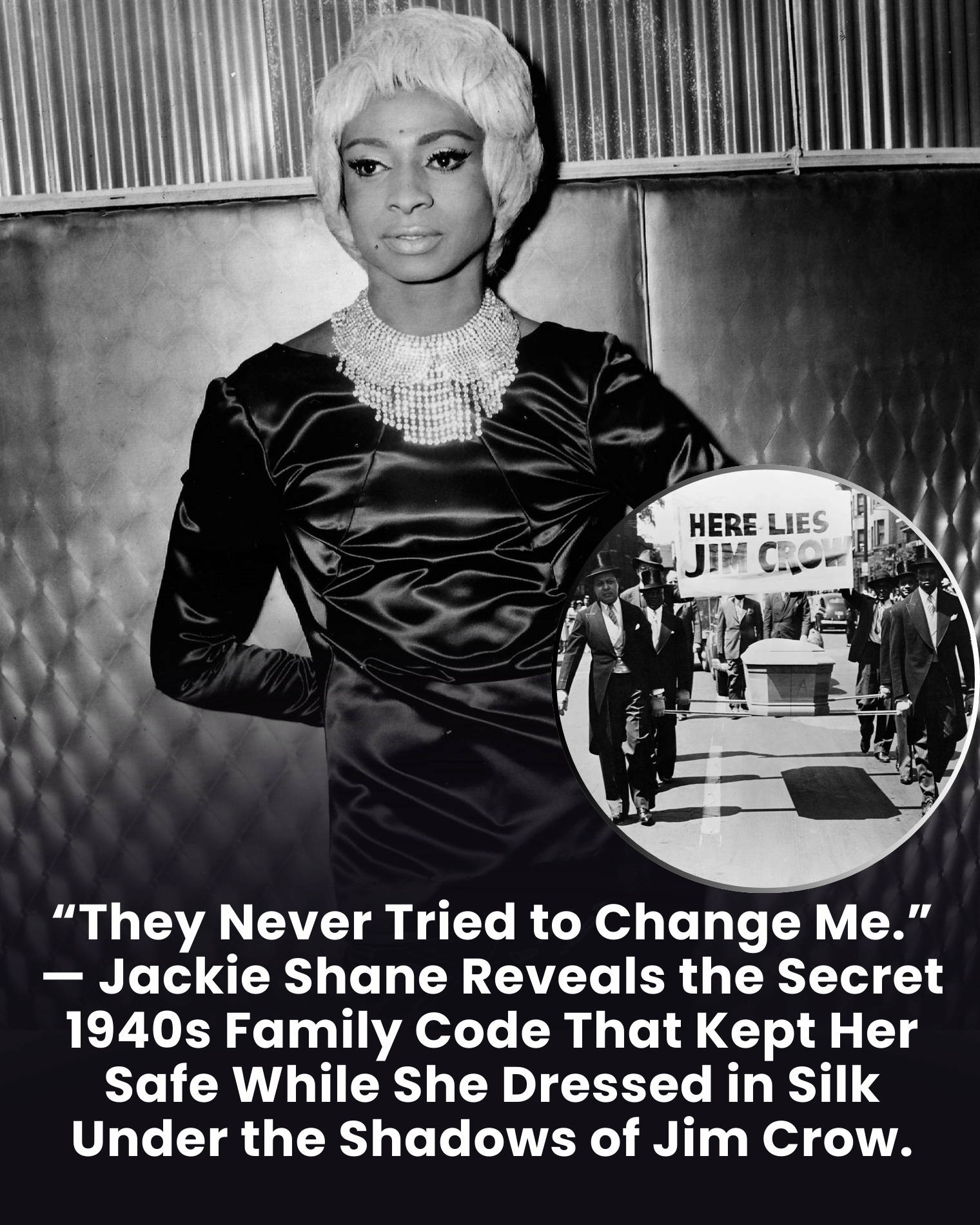
Long before she became a cult soul icon, Jackie Shane was a child growing up in the segregated South of the 1940s — a time and place where deviation from rigid social norms could invite danger.
Yet inside her home, something extraordinary was happening.
While the world outside enforced Jim Crow laws and suffocating expectations of gender and race, Jackie's family quietly constructed a sanctuary. She later described a household led by strong women — her mother and aunts — who formed what she called a protective circle. They understood the stakes of the outside world, but they refused to let that fear reshape who she was inside their walls.
"They never tried to change me," Jackie would say in later interviews.
From a young age, she gravitated toward silk fabrics, elegant gestures, and the feminine energy that felt natural to her. In many Southern homes of that era, such expressions might have been punished or suppressed. In Jackie's home, they were met with steady affirmation.
One moment remained etched in her memory: her mother looking directly at her and saying, "You are who you are."
Those five words became armor.
In the 1940s South, such acceptance was not passive. It was radical. A Black child expressing gender nonconformity already lived at the intersection of vulnerability and scrutiny. For her family to affirm her identity was an act of rebellion — quiet but defiant.
They developed what Jackie described as an unspoken code: inside the home, she was safe. Outside, she would move with caution. The lesson wasn't about shrinking. It was about survival.
That psychological foundation shaped everything that followed.
When Jackie eventually moved north and began building her music career in Toronto during the 1960s, she stepped onto stages as herself — not disguised, not apologetic. Her voice, rich and commanding, filled clubs with a confidence rooted not in bravado but in certainty.
She did not present as an experiment. She presented as truth.
Audiences were captivated not only by her vocal power but by her refusal to explain herself. In an era when openly transgender performers were virtually unheard of in mainstream music spaces, Jackie existed without footnotes.
That courage did not begin under stage lights.
It began in a Southern living room where women chose love over fear.
The acceptance she received at home gave her something many never find: internal stability. Critics could question. Society could marginalize. But the core of her identity had already been validated by the people who mattered most.
The contrast between the hostile public climate and the sanctuary of her childhood makes her story even more striking. While the world built walls, her family built a shield.
When Jackie Shane later commanded the stage in silk dresses and towering hair, she wasn't performing defiance.
She was living it.
And in doing so, she carried forward a 1940s family code that quietly declared something revolutionary: survival begins with being seen — and loved — exactly as you are.